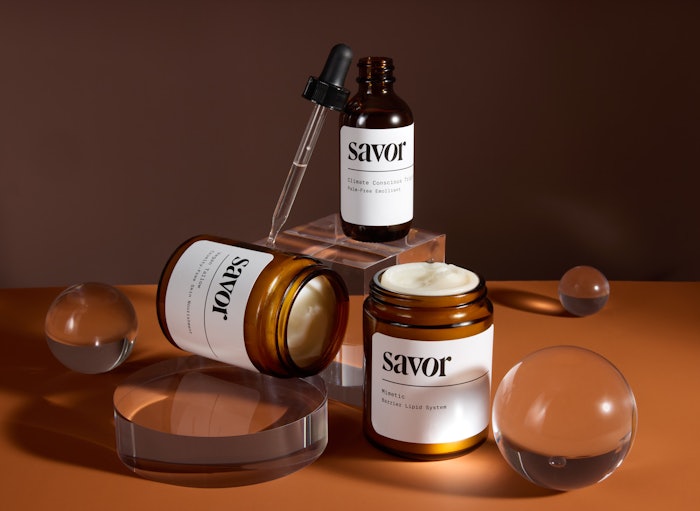
 Kathleen C. Alexander, co-founder and CEO at Savor.Savor
For beauty executives grappling with palm oil exposure, petroleum reliance and increasingly volatile agricultural supply chains, Savor’s proposition is blunt. It designs lipids directly from carbon—no crops, no plantations, no animals—cutting emissions by more than 90% compared to tropical oils while delivering the sensorial performance formulators expect.
 The company plans to expand its PCB portfolio through 2026 and is actively engaging brands, formulators and distributors.Savor
Savor’s move into beauty follows a breakout year in food. In 2025, the company began commercial production of Savor Butter, which landed in Michelin-starred kitchens and helped earn the startup spots on Fast Company’s Most Innovative Companies and TIME’s Best Inventions lists. Its 25,000-square-foot facility is now producing metric tons of fats annually—capacity that made expansion into adjacent, higher-margin categories inevitable.
 Savor isn’t positioning itself as a niche “green” ingredient supplier, but as an alternative feedstock model for beauty—what the company calls a shift from extraction-based to creation-based ingredients.Savor
From an industry standpoint, that integration is the point. Savor isn’t positioning itself as a niche “green” ingredient supplier, but as an alternative feedstock model for beauty—what the company calls a shift from extraction-based to creation-based ingredients. Using proprietary thermochemical processes and inputs like captured CO₂, green hydrogen and methane, Savor can tune fatty acid profiles for consistency and performance, a persistent pain point for plant-derived oils.
The company has already advanced its first INCI submission, clearing a regulatory path for formulators. Early traction is coming from contract manufacturers and chemists rather than marketing-led sustainability teams—a signal that performance is driving interest. At Cosmoprof North America in Miami, Savor featured high-functionality swaps in skin care, hair care and OTC applications.
For large beauty brands, the timing is notable. As ESG commitments collide with supply constraints and consumer scrutiny, “drop-in” ingredients with radically different sourcing stories are increasingly valuable. Savor is betting that lipids—workhorse ingredients that touch nearly every formula—are where that shift will happen first.
The company plans to expand its PCB portfolio through 2026 and is actively engaging brands, formulators and distributors. If its food-to-beauty crossover succeeds, Savor may offer a preview of where ingredient innovation is heading: less farm, less well, more lab—and fewer trade-offs between performance and planet.