Mane is putting €45 million behind fragrance creation with a new Fragrance Design Centre at its headquarters in Le Bar-sur-Loup, France, further strengthening the company’s long-standing connection to the Grasse region.
Deep dive: Mane’s Growth Playbook for a Fragmented Fragrance Economy
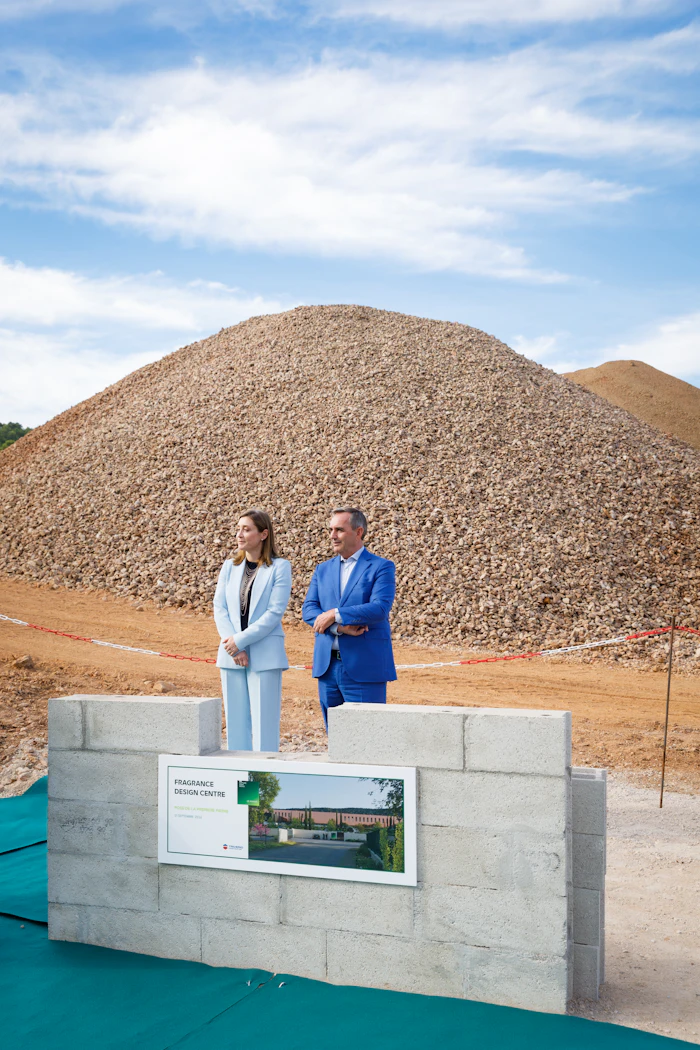
The foundation stone was laid September 21 for the 8,900-square-meter facility, which is scheduled to open in 2028. The center will bring together approximately 250 employees involved in the creation, evaluation and development of fragrances for consumer goods, including perfumers, evaluators, scientific experts, development teams and technical staff.
The project is designed to concentrate multiple stages of the fragrance development process under one roof, creating a dedicated environment for collaboration between creative, technical and scientific disciplines. For fragrance teams, the facility is positioned as a hub for developing new consumer fragrance concepts while connecting perfumery expertise with evaluation and technical capabilities.
The investment also reinforces Mane’s roots in Grasse, where the family-owned company traces its origins to Victor Mane’s transformation of locally cultivated flowers and plants into perfumery raw materials more than 150 years ago. What began as a local distillery has evolved into a global flavor and fragrance business with 54 R&D centers and 31 manufacturing sites across 41 countries, employing more than 8,500 people.
 An architect's rendering of the new facility; the center will bring together approximately 250 employees involved in the creation, evaluation and development of fragrances for consumer goods, including perfumers, evaluators, scientific experts, development teams and technical staff.Mane
Recently, Perfumer & Flavorist+ spoke with Xavier Ormancey, fragrance consumer goods director, EMEA, to learn more about the strategy behind the new site.
Q&A: Inside Mane’s €45 Million Bet on the Future of Fragrance Creation
What changes in the fragrance creation process will become possible by bringing perfumers, evaluators, scientists, development teams and technical staff together under one roof?
Ormancey: Close collaboration between perfumers, evaluators, scientists and technical teams is already at the heart of how Mane works. The Fragrance Design Centre will take this further by bringing the entire chain of expertise together in a single location, around 250 people, including, for the first time, our commercial teams alongside creation, research and product development.
This is the real step change. Having sales, marketing and creative-technical functions under the same roof means client insight, competitive intelligence and market reality feed directly into creation, in real time rather than through successive handovers.
A second decisive factor is proximity: the center will stand just a few meters from our Innovation Centre. Direct, daily access to our corporate research teams (in both technologies and ingredients), will significantly accelerate the path from scientific discovery to finished fragrance.
With the center scheduled to open in 2028, what emerging technologies, consumer trends or shifts in fragrance development is Mane designing the facility to accommodate?
Ormancey: The facility is being designed to support a more data-informed approach to fragrance creation, while preserving the essential role of human creativity and expertise.
It will include advanced capabilities for sensory analysis, with the capacity to process larger volumes of data to support the models driving Mane’s digital transformation. The center will also support digital collaboration, faster prototyping and more efficient product development.
We are preparing for growing demand for:
- greater personalization;
- more sustainable ingredients, processes and solutions;
- increased transparency and traceability;
- new product formats and sensory experiences;
- and fragrances that respond to increasingly diverse consumer expectations.
Dedicated facilities will allow fragrances to be evaluated in conditions that closely reflect real consumer use, with direct access to market products as a source of inspiration and benchmarking. The Fragrance Design Centre will also produce large sample volumes for consumer studies across the EMEA region, deepening our understanding of olfactory markets and product performance.
What specific capabilities or ways of working will the €45 million investment enable that Mane cannot achieve through its existing fragrance facilities and global R&D network?
Ormancey: The Fragrance Design Centre is not intended to replace Mane’s existing fragrance facilities or global R&D network. It will complement them by creating a dedicated, highly integrated ecosystem focused on consumer goods fragrance development.
The €45 million investment delivers a level of integration difficult to achieve across separate sites, together with capabilities including:
- a dedicated Neuroscience & Emotion Room, to better understand the emotional response fragrance creates;
- innovative equipment and protocols supporting our fast-growing Malodor Control strategic platform;
- state-of-the-art sensory analysis and consumer-relevant evaluation facilities;
- application laboratories of the highest standard, decisive in consumer goods, where a fragrance is only as good as its performance in the final product;
- capacity for large-scale regional consumer studies;
- shared spaces designed for cross-functional problem-solving, with room for future growth.
With 250 people spanning perfumery, evaluation, science, development and technical functions, how will the center change the way fragrances move from initial concept to commercial product?
Ormancey: The Fragrance Design Centre will shorten the path from concept to commercialization by enabling teams to work in parallel.
Ideas can move between laboratory, evaluation, application and development without the delays inherent to separate locations, with scientists, technical teams and commercial colleagues contributing from the outset.
It will also raise our execution speed and business excellence standards. A brand-new fragrance robot, for example, will substantially increase the automation rate of our fragrance oil compounding.
Fragrances will be tested, refined and adapted continuously, improving performance, feasibility and market relevance.
The goal is not simply speed, but a process that is more connected, more collaborative and more effective—from first creative concept to final commercial product.
What are the biggest strategic bets behind the facility—in terms of technology, consumer expectations or fragrance development—that MANE expects will shape the center’s priorities when it opens in 2028?
Ormancey: Our core belief is that the future of fragrance depends on a closer relationship between human creativity, scientific expertise and technology, including artificial intelligence, all connected to commercial and consumer reality.
Five developments will shape the Fragrance Design Centre’s priorities:
- The continued importance of human creativity and expertise, supported by increasingly powerful digital and scientific tools.
- A deeper understanding of consumer emotions, behaviors and preferences, based on sensory science, market knowledge and consumer studies.
- The need for faster innovation, as brands and consumers increasingly expect new experiences and shorter development cycles.
- The acceleration of sustainable fragrance development, including the search for more responsible ingredients, processes and formats.
- The growing diversity of consumer expectations, requiring more personalized, transparent and culturally relevant solutions.
The Fragrance Design Centre has therefore been designed to remain flexible. Technologies, consumer behaviors and market expectations will continue to evolve between now and its opening. The center must be capable of adapting to these changes while remaining focused on its core purpose: bringing creativity, science, technology and consumer understanding together to create the fragrances of tomorrow.