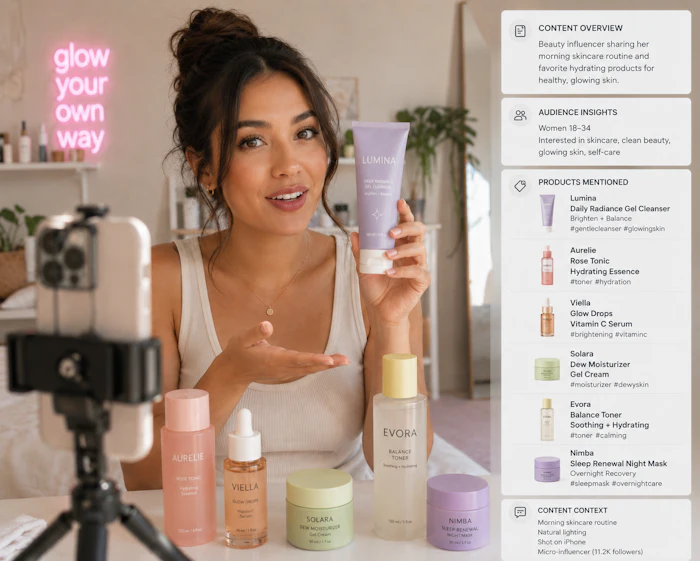
Micro-influencer content is rapidly evolving from an awareness tactic into a critical discovery asset as AI-powered answer engines reshape how consumers find products. New data from influencer marketing platform Statusphere shows enterprise brands increased social SEO-focused creator campaigns by 153% in 2025, reflecting a growing recognition that content created by influencers is increasingly being surfaced by AI tools such as ChatGPT, Claude, Gemini and Perplexity.
"The smartest beauty brands are no longer briefing creators only for engagement," says Kristen Wiley, founder and CEO at Statusphere. "They are briefing them for discoverability."
Wiley continues, "That means thinking about the exact questions a consumer may ask ChatGPT, Gemini, Claude, TikTok or Google when looking for a product, whether that is 'best mascara for sensitive eyes,' or 'clean foundation with buildable coverage,' and then designing creator briefs that help the brand show up in those moments."
She notes, "Our data shows enterprise brands ran 153% more social SEO-focused creator campaigns in 2025 than in 2024, which signals a clear shift in how brands are thinking about creator content. A creator post is no longer just a short-term awareness asset. It is becoming part of a brand’s long-term discovery infrastructure."
Finally, Wiley says, "Engagement still matters, but it is no longer the only measure of success. Increasingly, brands are asking: did this content create the right associations, around the right keywords, with the right consumers, in the places where people and AI systems are discovering products?"
For beauty marketers, the implications are significant. As AI-driven discovery begins to siphon traffic from traditional search engines, creator content optimized around product keywords, reviews, tutorials and comparisons is becoming part of the infrastructure that powers product recommendations. Statusphere's findings suggest brands are responding by treating influencer content less as a short-lived social activation and more as an owned discovery layer—one that can be amplified across paid media, retail channels and search ecosystems.
"Micro-influencers are becoming an important part of the input layer for AI-driven discovery," says Wiley. "AI answer engines and search platforms are increasingly influenced by the content ecosystem around a product, including reviews, videos, social posts, product pages and third-party content. For beauty brands, that matters because so much product education now happens through creators. Consumers want to understand texture, shade match, skin type, routine fit, before-and-after results and real-life use cases, and micro-influencers are often the ones creating that context at scale."
She adds, "This is where micro-influencers are uniquely powerful. A single celebrity post may drive awareness, but hundreds of highly relevant creators can create repeated, specific associations around a product across TikTok, Instagram, YouTube and search-indexed content. For example, YouTube citations are already appearing in 78% of Google AI Overviews for product comparison searches, showing how creator-led content is increasingly part of the discovery path. The beauty brands that can scale precise, keyword-rich, authentic creator content across platforms will have a structural advantage as AI-driven product discovery continues to grow."
The report also highlights a sharp increase in allowlisting, with brands running three times more creator-generated ads year-over-year, underscoring growing confidence in influencer content as a performance marketing asset. Beauty ranked among the most active sectors for micro-influencer partnerships, while TikTok remained the most requested platform for collaborations.
As allowlisted influencer content and paid amplification become central to distribution, Global Cosmetic Industry asked Wiley how beauty marketers are balancing authenticity with the need to engineer creator posts that perform in both social feeds and AI search environments.
"The brands getting this right are not choosing between authenticity and performance," she explains. "They are designing for both from the start."
Wiley notes, "Authenticity starts with the creator match. If the creator is genuinely aligned with the product, the content naturally feels more credible. At Statusphere, we match creators to brands using 300+ targeting parameters, so a beauty brand can find creators based on highly specific attributes like skin concerns, hair type, makeup preferences, shopping behavior and lifestyle fit."
She continues, "From there, we see the strongest results when brands provide clear strategic guardrails, but give creators the freedom to do what they do best: create content that feels native to their voice. The brief should point creators toward the right use cases, keywords, and consumer questions, while still allowing them to share their real experience in their own words and creative style. That balance matters even more as brands amplify creator content. We are seeing brands use allowlisting at 3x the rate year-over-year, because when creator content is matched well and briefed well, it can perform in paid environments without feeling like a traditional ad."
Wiley concludes, "The key is to treat SEO intent, paid performance and authenticity as connected, not separate. The best creator content now needs to work in the feed, in search results and increasingly in AI-driven discovery environments."
Looking ahead, Statusphere identifies YouTube Shorts and Amazon as two key battlegrounds for AI-era visibility. With YouTube content increasingly cited in AI-generated search results and product pages with video consistently outperforming those without, beauty brands may need to rethink influencer programs as part of a broader search and commerce strategy.