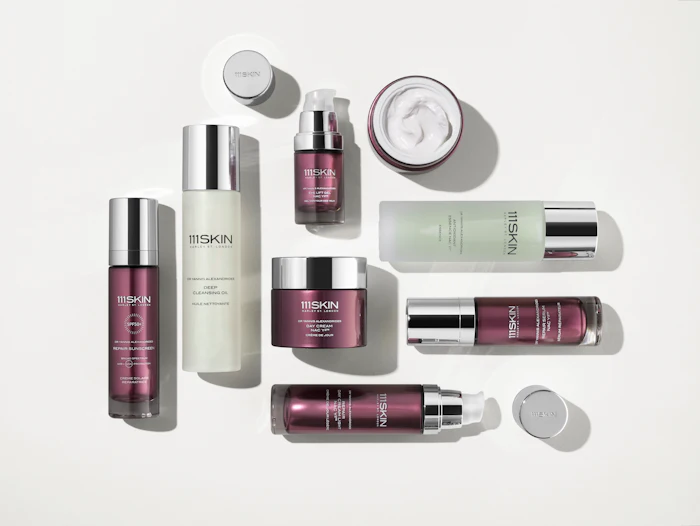
Amid ongoing questions about a potential merger with Puig, The Estée Lauder Companies has taken a minority stake in 111Skin, underscoring the growing importance of clinically grounded skin care in today’s prestige beauty market. Founded in 2012 by plastic and reconstructive surgeon Yannis Alexandrides, MD, the brand was originally developed to support post-procedure recovery, embedding clinical performance at the core of its product philosophy.
Central to 111Skin’s positioning is its proprietary NAC Y2 complex, designed to support skin repair and resilience. This clinical foundation has enabled the brand to build a portfolio of more than 30 products, many inspired by in-clinic treatments and focused on measurable outcomes such as improved recovery, barrier function, and overall skin quality. Its Black Diamond and Reparative lines exemplify this treatment-led approach, translating surgical insight into high-performance topical formulations.
The investment reflects a broader shift in beauty toward convergence with medical aesthetics, where consumers increasingly expect skin care to deliver results comparable to professional procedures. In this context, clinically validated ingredients, physician-led development, and efficacy-driven claims have become key differentiators. Brands like 111Skin, which originate from real-world clinical use cases, are particularly well positioned to meet demand for products that bridge the gap between treatment and daily care.
With a global footprint spanning North America, Europe and Asia, and distribution across luxury retail, spa, and direct-to-consumer channels, 111Skin operates in a fast-growing segment defined by science-backed innovation. The continued involvement of Alexandrides ensures that clinical rigor remains central as the brand scales—an increasingly critical factor as the industry prioritizes performance, credibility, and demonstrable results.