K-beauty’s U.S. retail boom is entering a new phase, and this time, Korea’s biggest beauty retailer is coming directly to American consumers.
Olive Young, South Korea’s dominant beauty and lifestyle chain, will officially open its first U.S. brick-and-mortar location on May 29, 2026 in Pasadena, California, marking one of the most ambitious Korean beauty retail expansions in the American market to date. Alongside the 8,647-square-foot flagship, the company is also launching a dedicated U.S. e-commerce platform designed to eliminate import friction and broaden nationwide access to Korean beauty brands.
 Olive Young appears intent on competing aggressively on all four fronts. Its U.S. strategy includes a three-tier membership program, rotating merchandising campaigns, retailer-led sampling initiatives, and synchronized online-offline rewards. TOlive Young
Often described as Korea’s answer to Sephora and Ulta combined, Olive Young operates more than 1,380 stores in South Korea and has become one of the most influential discovery platforms in global beauty. Its arrival in the U.S. market reflects the rapid mainstreaming of K-beauty across American retail channels, as Korean brands move beyond niche specialty distribution into mass, prestige, club, pharmacy, and omnichannel environments.
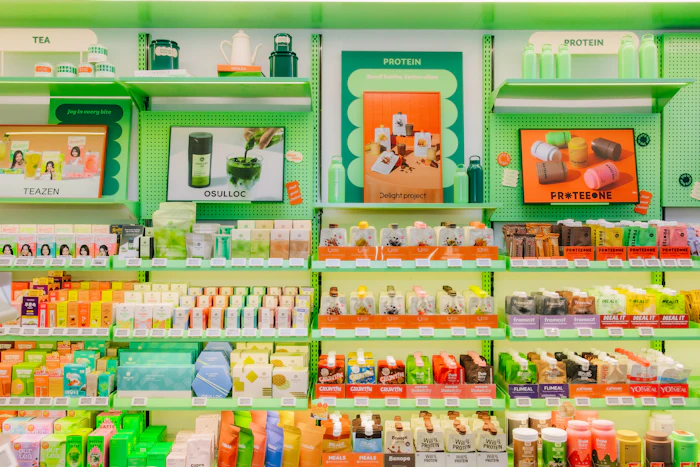
The Pasadena location brings Olive Young’s signature “discovery retail” model to the U.S. market, featuring roughly 400 brands and 5,000 SKUs spanning skin care, makeup, wellness, hair care and inner beauty. The assortment blends trending Korean brands including Anua, Biodance, fwee, Mediheal, rom&nd, Torriden, Unove, and Mise-en-scène with globally recognized names such as CeraVe, Kiehl’s, La Roche-Posay, Sol de Janeiro, Supergoop!, Urban Decay and The Ordinary.
The retailer is also leaning heavily into experiential beauty retail, a category strategy that continues to gain momentum globally. The Pasadena store includes dedicated skin care testing zones, water-basin cleansing stations, skin scanning technology, scalp analysis services, and “The Beauty Lab," where shoppers can receive personalized skin care lessons based on diagnostic insights.
 Amorepacific-owned Mamonde launched exclusively through Amazon Premium Beauty targeting Gen Z consumers with digitally driven floral skin care positioning. Mamonde
The opening comes amid a wave of aggressive K-beauty retail expansion across the U.S. market in 2026. Earlier this month, viral makeup brand I’m Meme entered 1,900 Walgreens locations nationwide, while Amorepacific-owned Mamonde launched exclusively through Amazon Premium Beauty targeting Gen Z consumers with digitally driven floral skin care positioning. Meanwhile, Korean skin care brand Mixsoon expanded from Costco.com into approximately 500 Costco warehouse locations across the U.S. market, signaling growing mainstream retailer confidence in Korean skin care demand.
 Korean skin care brand Mixsoon expanded from Costco.com into approximately 500 Costco warehouse locations across the U.S. market.Mixsoon
Olive Young’s U.S. debut is also expected to provide an important launchpad for emerging Korean brands seeking stronger North American visibility. Purito Seoul, one of the latest brands joining the retailer’s U.S. assortment, said the partnership would accelerate its offline expansion strategy as demand for minimalist, barrier-focused skin care continues to rise among American consumers.
 Purito Seoul, one of the latest brands joining the retailer’s U.S. assortment, said the partnership would accelerate its offline expansion strategy as demand for minimalist, barrier-focused skin care continues to rise among American consumers.Purito
Much of the category’s momentum has been fueled by TikTok virality, ingredient-focused skin care education, and growing consumer appetite for “glass skin,” skin barrier repair, and low-irritation formulations. But industry observers increasingly see the next phase of K-beauty growth being driven less by trends alone and more by retail infrastructure — including localized fulfillment, experiential merchandising, loyalty ecosystems, and physical discovery environments.
Olive Young appears intent on competing aggressively on all four fronts. Its U.S. strategy includes a three-tier membership program, rotating merchandising campaigns, retailer-led sampling initiatives, and synchronized online-offline rewards. The company also confirmed plans to expand beyond California into major East Coast markets including New York before targeting Southern and Central U.S. regions.
“Our U.S. debut marks an important step in bringing a more personalized and seamless beauty discovery experience to American consumers,” said Gaeun Kwon, CEO of Olive Young USA, in a statement announcing the launch.