For decades, body care has lagged behind facial skin care in both innovation and consumer expectations. That is changing fast. As shoppers increasingly seek clinical efficacy, active ingredients and treatment-focused routines below the neck, body care has emerged as one of beauty's fastest-growing categories—outpacing facial skin care by a wide margin.
Dewsy is betting this shift is permanent. Built around proprietary Mini Molecule Technology and "face grade" formulations designed specifically for body skin, the startup aims to challenge longstanding assumptions about what body care can deliver.
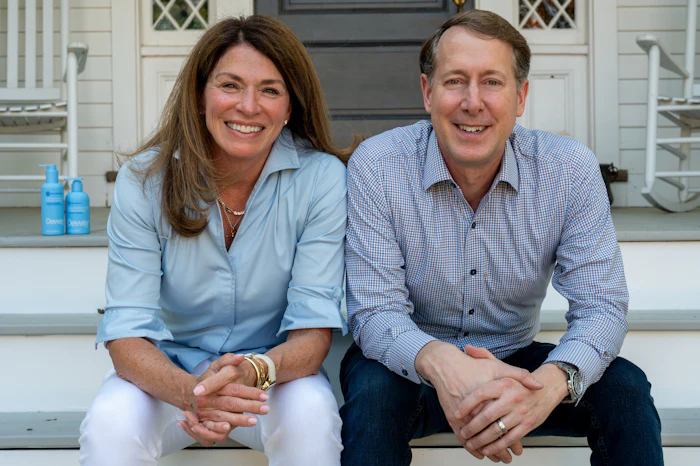
Fresh off a $4 million funding round, co-founder and CEO Kathy Widmer and co-founder and CCO Barry Bruno discuss why they believe the category is undergoing a structural transformation, why efficacy—not just ingredients—will define the next generation of products, and how delivery technology, clinically effective active levels and AI-driven business practices could reshape the competitive landscape.
Is the body care growth trend temporary or structural, and why build a standalone brand?
Widmer: The 23% growth in body care versus 4% in facial skin care is not a trend we think will reverse. It reflects something structural: two decades of ingredient education finally reaching the body. The face skin care consumer spent 20 years learning about retinoids, ceramides, peptides and hyaluronic acid, building routines with clinical logic and real expectations for results. That same woman looked at her body care shelf at some point and recognized the mismatch. The category growth we're seeing is that recognition becoming routine commercial behavior.
We built a standalone brand rather than extending a facial franchise for a specific reason. Body care has different formulation challenges than facial care—thicker stratum corneum, larger surface area, different usage patterns—and those challenges require dedicated science, not repurposed face formulas in bigger bottles.
A standalone brand signals that commitment in a way a line extension can't. It also gives us the freedom to own the positioning at masstige price points, which is where the fastest growth is happening. Masstige grew 14% in 2025—the highest of any pricing segment in skin care. That's not where extensions from premium facial brands typically play, but it's exactly where Dewsy belongs.
 "Body care has different formulation challenges than facial care—thicker stratum corneum, larger surface area, different usage patterns—and those challenges require dedicated science, not repurposed face formulas in bigger bottles," says Widmer.Dewsy
What does "face-grade body care" actually mean, and where do most brands still fall short?
Widmer: It means two things, and most brands address neither.
The first is active concentration. Face skin care has expectations and standards—a product claiming to feature retinol is expected to have it at a level where it actually produces a measurable effect. Body care has operated under looser norms where the active often appears on the label at a concentration that justifies the name without necessarily justifying the result. The consumer buying a ceramide body lotion often has no idea whether she's getting a therapeutic amount or a trace. There's even an industry name for the practice: "pixie dusting."
The second is delivery. Body skin's barrier is structurally harder to penetrate than facial skin. Even at effective concentrations, actives that can't get past the stratum corneum are biologically inert. Most body care formulations weren't designed to solve that problem because most of the category never seriously engaged with it. That's where our proprietary Mini Molecule Technology comes into play. It leverages sonic cavitation to make molecules small enough to past the stratum corneum.
Closing both of those gaps simultaneously—at a price point women can sustain as a daily routine, not an occasional indulgence—is what we built Dewsy to do.
What data supports Mini Molecule Technology, and how are you approaching substantiation?
Widmer: Let me answer the underlying question behind that question first, because it matters for context. As noted earlier, the industry has a well-documented formulation practice that insiders call "pixie dusting"—including actives on the ingredient label at concentrations below their clinically effective threshold, primarily for marketing and claim purposes. A product can accurately say it "contains retinol" or "features ceramides" while including those ingredients at levels that produce no measurable skin benefit. The label is technically honest. The efficacy isn't.
Pixie dusting is especially pervasive in body care because the economics push that direction. Larger volumes, greater surface area, and a consumer historically unwilling to pay facial-care prices for her body all create pressure toward cheaper formulations. The result is a category where active ingredient claims are nearly universal and clinically meaningful concentrations are nearly absent.
We formulate against that standard deliberately. The ceramide levels in Dewsy Down Deep Body Lotion and Dewsy Down Deep HA Body Serum are at therapeutic concentrations, not cosmetic-claim levels. Every key ingredient in every Dewsy product is present at the level where the science says it works.
Our exclusive Mini Molecule Technology addresses the second problem—delivery. We use ultrasonic emulsification to reduce the droplet size of active ingredient particles within the formula. Smaller droplets navigate body skin's thicker barrier more effectively than conventional emulsion particles. The mechanism is grounded in peer-reviewed biophysics; ultrasonic emulsification is a validated process in pharmaceutical and cosmetic formulation. Our proprietary, patent-pending application of that process is what no competitor in masstige body care has replicated.
On substantiation: we believe the era of claims-without-proof is ending, and we're not waiting for regulators or consumers to force the issue. We're building our dermatologist partnerships based around our clinical methodology and validation.
How hard has it been to get shoppers to adopt a body serum-plus-lotion regimen?
Widmer: Honestly, less hard than we expected—and the reason tells you something important about where the consumer already is. Our target consumer is women who are sophisticated about facial skin care and already have a multi-step face routine. She layers a serum under a moisturizer every morning and evening because she understands that serums deliver actives and moisturizers lock in hydration and protect the barrier. The behavioral architecture already exists. We're not asking her to learn a new behavior; we're asking her to extend one she already performs—daily.
What we've observed early on is that the serum step resonates most strongly. Women who add a body serum to their routine often describe it as the moment the category "clicks" for them—it's the step that most clearly signals that this isn't just another body lotion with a clever label. The serum is the proof point that we're serious about efficacy. The lotion closes the routine, but the serum opens the conversation about what body care can actually be.
What is Dewsy's long-term competitive moat?
Bruno: It's the combination of two things that no competitor in our price tier currently offers simultaneously.
The first is effective active concentrations. Most body care marketed as clinical or active-forward is pixie-dusted—the actives are present at label levels, not therapeutic levels. Dewsy formulates every product at clinically effective concentrations. That's a standard any brand could choose to meet with sufficient formulation investment, but most have chosen not to because the economics of body care create pressure in the opposite direction.
The second is Mini Molecule Technology, our proprietary delivery system. Effective concentrations are necessary but not sufficient if the actives can't navigate the skin's barrier. Mini Molecule Technology is a durable moat in a way that effective concentrations alone are not—a competitor can raise its active levels, but competing against our delivery technology requires building a different proprietary system from the ground up.
Together, those two things create a compounding efficacy argument: most body care fails the consumer not once but twice—not enough active to work, and even if there were, most of it wouldn't reach her skin. Dewsy solves both problems. That's a complete efficacy narrative. That combination is the moat.
 "Most body care marketed as clinical or active-forward is pixie-dusted—the actives are present at label levels, not therapeutic levels," says Bruno. "Dewsy formulates every product at clinically effective concentrations."Dewsy
What lessons are you applying from large CPG—and which conventions are you deliberately rejecting?
Widmer: Over 25 years in this industry provides a clear view of what large CPG gets right – and what it’s almost structurally incapable of changing.
- What we’ve kept: Strong focus on the consumer, product quality and testing, and the kind of discipline around brand that is a unique and fundamental strength of big CPG.
- What we’re walking away from: The notion that generic lotions are sufficient for body skin while facial skin has been treated to decades of proven active ingredients at clinically proven strength. On the business side, we differentiate ourselves from large CPG through speed in everything. And we are AI-native—not AI-curious or AI-experimenting. AI is woven into every aspect of our business and it’s a huge advantage compared to the heavy lift of retro-fitting AI into a large, process-driven and complex CPG organization.
What will the most sophisticated body care routine look like in five years?
Widmer: The face skin care roadmap is a useful predictor. What we saw in facial care over the past 20 years—the move from basic moisturizer to actives to targeted treatment to routine architecture—is now happening in body care, compressed into a shorter timeframe because the consumer is already educated.
Five years from now, I expect the sophisticated consumer to have a body skin care routine with the same intentionality she brings to her face routine: a body serum with a specific active matched to a specific concern (firmness, tone, texture, KP), layered with a barrier-supportive moisturizer, and anchored by year-round body SPF as a true daily habit rather than a summer afterthought.
Personalization will be part of it—not necessarily AI-driven diagnostics, but the kind of routine personalization that already happens in face care when a consumer decides she needs to address hyperpigmentation or barrier compromise. She'll apply that same logic to her body.